
What Latimer County Probate Covers
Probate is the court process that moves a dead person's property to the right hands. Oklahoma has no separate probate court. The District Court hears these cases through its probate division instead. In Latimer County, that means the Latimer County District Court takes wills, estates, guardianships, and conservatorship matters. Title 58, the state's Probate Procedure law, gives the District Court the power to prove wills, grant letters, appoint appraisers, compel accounts, order sales, pay debts, and split estates among heirs.
The Oklahoma Supreme Court sits over every District Court in the state and sets the rules they all follow.
The Oklahoma Supreme Court page lists the justices and lays out how the state courts fit together.
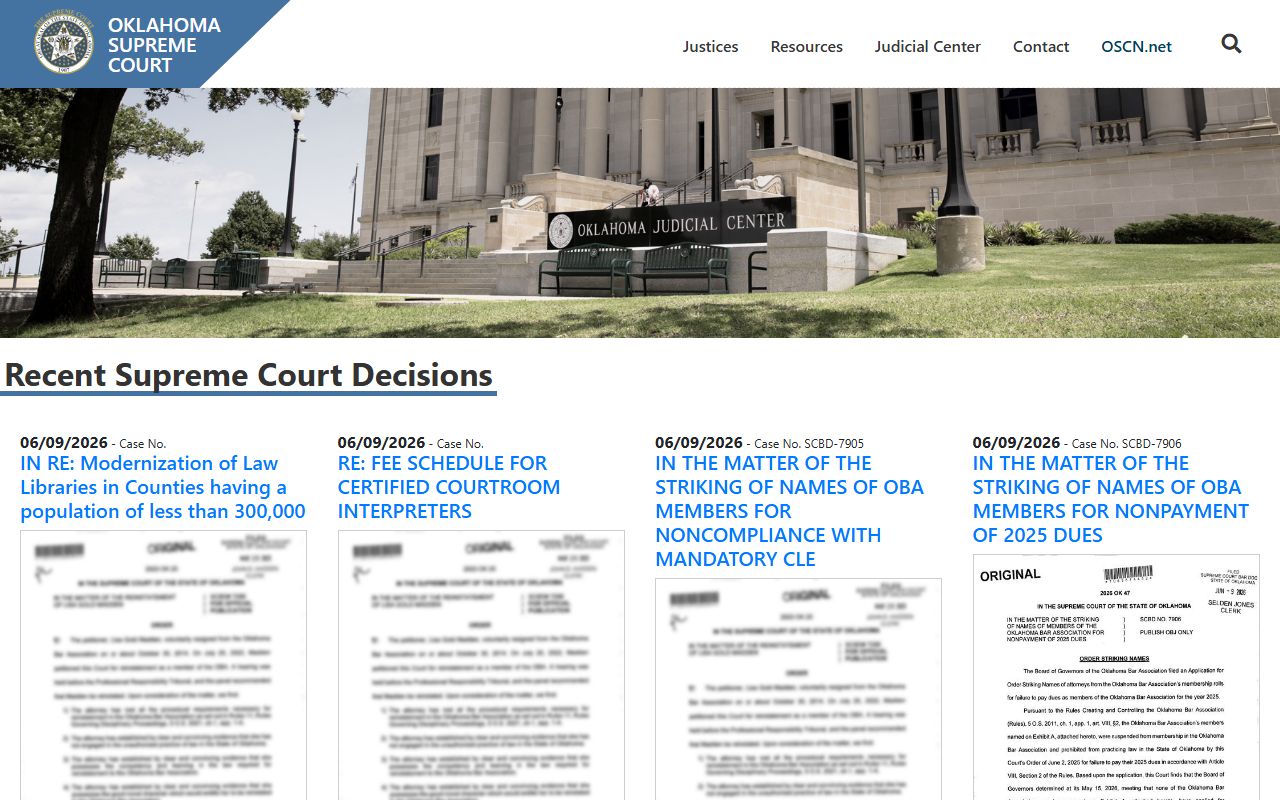
Probate cases stay at the Latimer County courthouse, yet the power to decide them flows down from that top court. Guardianship of a minor or of an adult who cannot care for themselves runs through the same division, under Title 30, the Guardian and Ward law.
Probate Terms Defined
Probate leans on old legal words that trip up many readers. A short glossary clears up the terms you will meet in a Latimer County estate file. Each one points to a role or a step in the case.
- Testator
- The person who made the will. The will speaks for the testator after death.
- Executor
- The person named in a will to carry out its terms and close the estate.
- Administrator
- The person the court names to run an estate when there is no valid will or no named executor can serve.
- Personal representative
- The broad term for whoever the court puts in charge, whether executor or administrator.
- Intestate
- Dying without a will. State law then sets who inherits.
- Letters testamentary
- The court order that proves an executor's power to act for the estate.
- Guardianship
- A court role over a minor or an adult who cannot handle daily affairs or care.
- Conservatorship
- A court role focused on the money and property of a person who cannot manage them.
How to Search Latimer County Probate Records
Two free online channels carry Oklahoma court dockets. On Demand Court Records is linked from the county's official pages as its court-records tool, and Latimer sits in the court dropdown. The Oklahoma State Courts Network runs the official statewide docket, though it may ask you to pass a human-verification check. Search either one by the name of the person who died, the name of an heir, or a case number. Probate cases carry a PB prefix, and guardianships carry a PG prefix.
For blank forms and self-help, the Oklahoma Department of Libraries legal resources page links statewide court forms, including probate and guardianship material.
Those forms are statewide, not Latimer packets, so the Court Clerk stays the place to confirm what a local judge expects. A name search takes only a few steps once you know the path.
- Open ODCR or OSCN and pick Latimer among the Oklahoma District Courts.
- Type the decedent or party name as Last, First, or enter the PB or PG case number.
- Read the docket for the will, orders, letters, and hearing dates.
- Call or visit the Court Clerk for older files, sealed status, or certified copies.
Note: OSCN states that its online docket is a public convenience tool, and the court's own case-management record controls if the two ever disagree.
The Latimer County Court Clerk and Probate Division
The Latimer County Court Clerk keeps every District Court file, probate included. Melinda Brinlee holds the office and works with the probate, civil, juvenile, domestic relations, and small claims divisions. Her staff records and files permanent court proceedings, keeps the dockets, holds court-reporter transcripts, and collects court costs and fund deposits. The counter is the right stop for file inspection, certified copies, and any estate record that is not fully online.
Latimer County Court Clerk – Probate Division
109 N Central, Room 200
Wilburton, OK 74578
918-465-2011
Mon–Fri 8:00 a.m. to 4:30 p.m., open at noon
A certified copy is a clerk-attested copy that a bank, title office, or court will accept as proof. The same office handles vital documents tied to a family, so an estate search often crosses paths with Latimer County marriage and divorce records when heirs need to show how they are related.
Latimer County Probate Filing Fees
Latimer County does not post a probate fee sheet on its official pages. Costs still apply when an estate opens. The amounts depend on the case type, the value of the estate, and the orders a judge signs. The table below frames the usual Oklahoma cost categories rather than a posted local price list.
| Cost category | What it covers |
|---|---|
| Court costs | Filing and clerk costs set for the District Court probate case |
| Publication | Newspaper notice to creditors and other required notices |
| Executor or administrator fees | Compensation the court may allow the personal representative |
| Attorney fees | Counsel hired to guide the estate through probate |
| Certified copies | Clerk-attested copies of orders, letters, or the final decree |
The Oklahoma DHS guide notes that court costs, publication, executor or administrator pay, and attorney fees can all reach into an estate.
Note: Latimer has not posted a probate fee sheet, and other Oklahoma courts often list filing costs near $204.14 plus publication, so confirm current amounts with the Court Clerk.
What Latimer County Probate Records Show
A probate file grows as the case moves. It starts with a petition and builds toward a final order that splits the estate. Most of these papers are open to view through the docket or at the clerk's counter. The list below covers what a full Latimer County estate file tends to hold.
- The petition to probate a will or for letters of administration.
- Death information and the list of heirs or interested parties.
- The will, any codicil, proof of the will, or a statement of intestacy.
- Orders that appoint the personal representative and the letters issued.
- Notices to creditors, inventory and appraisal, claims, accountings, and the final decree.
The case number follows the common Oklahoma pattern of prefix, year, and a running number, such as a PB case for an estate. Financial entries, hearing dates, and document flags also show on the docket where the court allows them.
Wills and Letters in Latimer County Probate Records
A will names who should get the estate and who should run it. When the court accepts a will as valid, it issues letters testamentary to the named executor. When there is no will, the court grants letters of administration to an administrator it picks under state law. Those letters are the proof a bank or title office wants before it releases anything.
The Oklahoma DHS guide "About Your Will" explains that probate decides whether a will is valid, guards the rights of a spouse, minors, and creditors, pays taxes and debts, and sets how the estate is shared. It also notes that some Oklahoma counties let a person file a will with the court clerk for safekeeping.
Note: A will on file is not yet probated; the estate still has to open a case before any property can pass to the named heirs.
Latimer County Guardianship and Conservatorship Records
Guardianship and conservatorship cases run through the same probate division, but they do not open as wide. These files often hold medical proof, mental-health findings, and details about a person who cannot speak for their own care. Oklahoma law and court practice keep much of that record confidential or restricted, and minor guardianship records are guarded with special care.
The docket may still show that a PG case exists, the parties, and the basic orders. The deeper papers about a ward's health, finances, or capacity are usually closed to the general public. Access tends to belong to the parties, their attorneys, named agencies, or anyone a judge allows by order. Sealed estates, adoption, and mental-health matters follow the same closed pattern, so the Court Clerk is the right place to ask what a specific case will release.
Land Records Tied to Latimer County Probate
Probate often ends with property changing hands, and that step leaves a paper trail outside the court file. When an estate transfers real property, mineral interests, or clears a lien, the deed or affidavit is recorded with the Latimer County Clerk, Erin Adams, in Room 103 of the courthouse. That office is a different custodian from the Court Clerk, and it handles land records rather than court case files.
You can search those recorded instruments through the Latimer County land-records portal, which indexes documents and images. Judgment liens and tax warrants tied to a court case can also surface there. Pair a probate docket search with a land-record search when an estate involves a home, farmland, or mineral rights.
Small Estates and the Latimer County Probate Process
Not every estate needs a full probate case. Oklahoma law allows small-estate affidavit procedures and several nonprobate transfers under Title 58 and related statutes. The dollar thresholds and the kinds of property that qualify change with the statute, so check current law and ask the Court Clerk or an attorney before relying on a shortcut. Latimer County does not publish a local small-estate packet.
When formal probate is the right path, the case tends to follow a clear order from start to close.
- Decide whether the estate needs full probate, a small-estate affidavit, or only nonprobate transfers.
- File the petition in the Latimer County District Court if venue is proper.
- Give the required notices, publish a creditor notice if ordered, and obtain appointment and letters.
- Inventory the property and handle claims, taxes, and creditor issues.
- Seek a final order, file the closing accounting, and distribute the estate by decree.
Filing for court-appointed help, certified copies, and case status all run through the Latimer County Court Clerk, the same office that anchors the probate division.
Federal Estate Matters Beyond Latimer County Probate
Most estates never touch a federal courtroom. Probate is a state matter, and the Latimer County District Court handles it. A bankruptcy linked to an estate, or a federal claim against it, falls outside county probate and lands in the federal system instead. Those cases sit in a separate index with its own access and fee rules.
You can look up federal filings through the PACER Case Locator, the national index for U.S. courts.
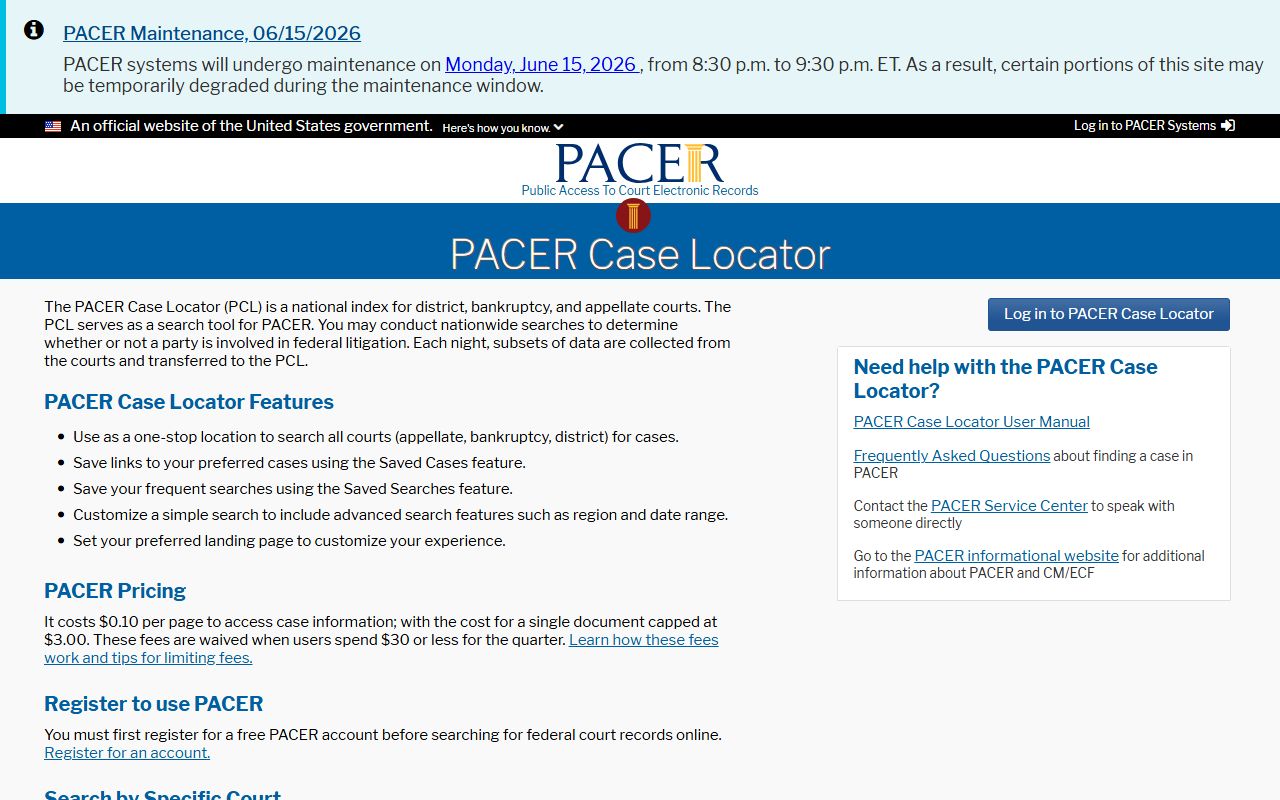
A PACER account and per-page fees apply, and the search reaches federal district and bankruptcy cases rather than county estates. For a routine Latimer County estate, start with the county channels first and treat PACER as the federal backstop.